
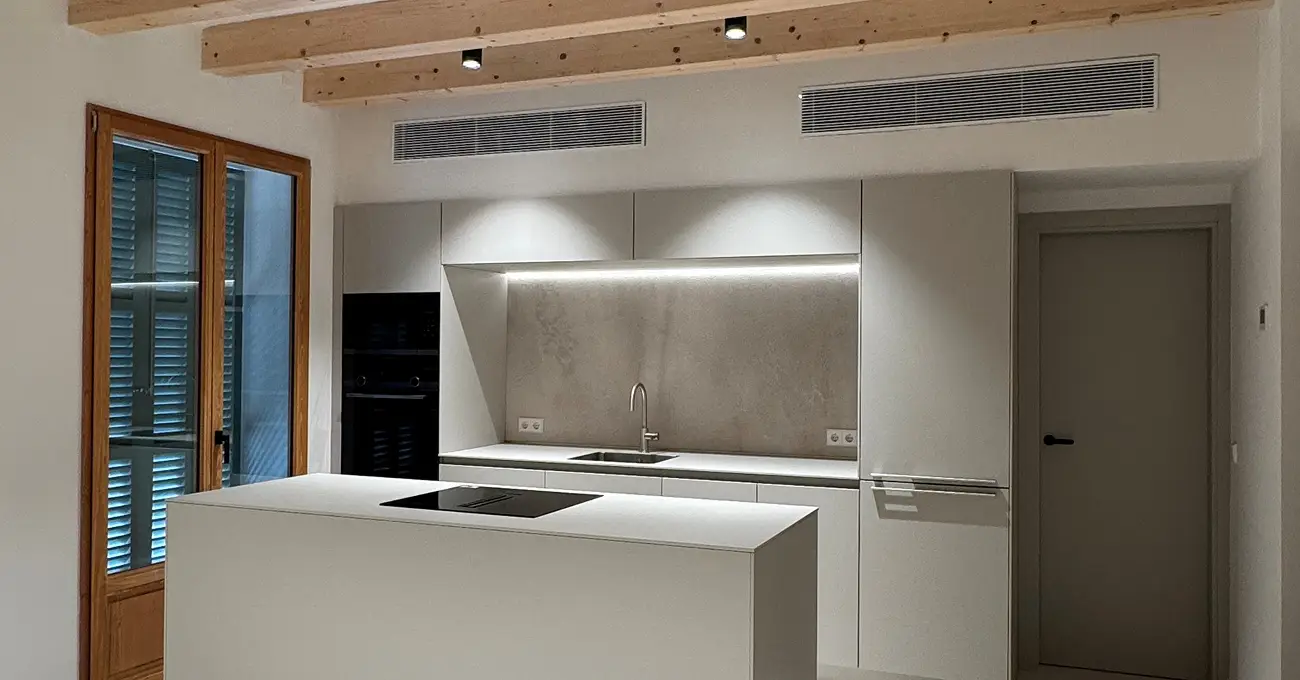
Replacing a bathroom, renovating a kitchen, extending a home or building a house from scratch all require different paperwork. Before you start, it is worth being clear about which works licence applies to your project, because choosing the wrong procedure can bring the works to a halt or lead to a fine. At Llull Sastre we have been building in Mallorca for more than 90 years, and this is one of the questions our clients ask us most often. Here is the answer.
Works licences in the Balearic Islands: what the law says
In the Balearic Islands, building permits are governed by Law 12/2017 on urban planning in the Balearic Islands (LUIB), updated in 2024 with several administrative simplification measures.
The law does not literally use the terms “minor works” and “major works”, even though everyone still calls them that. What it does distinguish is two procedures:
- Prior notification (comunicación previa), for straightforward works. This is what we know as a minor works licence.
- Planning licence (licencia urbanística), for larger works, normally requiring a technical project. This is the major works licence.
On top of that, each town hall sets out in its own by-laws which works fall into each category, so Palma, Calvià, Andratx or Pollença may each have their own particularities.
Minor works licence: prior notification
A minor work is technically simple and of limited structural significance, and does not require an architect’s project. In Mallorca it is processed through prior notification: you file the documentation at the town hall and, for straightforward works, you can start the next day. The town hall reviews the file afterwards and can stop the works if it finds that a licence was in fact required.
These are some typical examples of minor works:
- Replacing floors, tiles or sanitary fittings.
- Renovating a kitchen or bathroom without touching the structure.
- Replacing windows and joinery.
- Painting façades or repairing roofs.
- Installing solar panels on the roof or charging points for electric vehicles.
By contrast, prior notification cannot be used for works that affect the foundations or the structure, alter the volume or the number of dwellings, involve demolition, take place on protected rural land or affect listed buildings. In those cases a major works licence is required.
What about the “declaración responsable de obras”?
You have probably come across the declaración responsable de obras, the responsible declaration used for simple works in regions such as Madrid or Andalusia. In the Balearic Islands, its planning equivalent is prior notification: it works in much the same way, but under a different name and subject to the requirements of the LUIB. If you look for the procedure on your town hall’s website, what you will find is “comunicación previa”.
Major works licence: when it is compulsory
A major works licence is essential for larger projects, such as:
- Building new homes or buildings.
- Extensions and any increase in volume or floor area.
- Renovations affecting load-bearing walls, floor slabs or foundations.
- Demolitions.
- Swimming pools, in most municipalities.
- Full refurbishments, such as those we carry out in hotel construction and renovation in Mallorca.
All of these require a technical project signed by an architect or other qualified professional. The town hall has a maximum of three months to decide, counted from the moment the file is complete. Once the licence has been granted, the start of the works must be notified at least ten days in advance.
Works that need no permit at all
Some very small jobs are exempt from both a licence and prior notification. To qualify, they must meet all of these conditions: be carried out on urban land and inside an existing building, cost less than 3,000 euros, require neither a project nor technical supervision, and not affect protected buildings. When in doubt, the sensible thing is to file the prior notification.
Minor works vs. major works: a quick comparison
| Minor works licence | Major works licence | |
|---|---|---|
| Legal procedure | Prior notification | Planning licence |
| Type of work | Renovations without touching structure or volume | New builds, extensions, structure, demolitions |
| Technical project | No, except in specific cases | Yes |
| When you can start | The day after filing | After it is granted, with 10 days’ notice |
| Timescale | No waiting, reviewed afterwards | Up to 3 months from a complete file |
How to apply for a works licence, step by step
1. Define the work. Set out what you are going to do, where and on what budget. That will tell you which procedure applies.
2. Check with your town hall. Each municipality publishes on its website the types of work and the documents it requires.
3. Prepare the documentation. For minor works, the prior notification form, a description and budget of the work, photographs or sketches and the completion period, which cannot exceed two years, are usually enough. Major works additionally require the technical project, professional body approval where compulsory, the health and safety study, the waste management plan and any sector-specific authorisations.
4. File the application. You can do so online or at the municipal register. Companies and professionals are required to file electronically.
5. Pay the fees and ICIO. The tax on construction, installations and works is calculated on the material execution budget, and the rate varies from one municipality to another.
6. Keep the paperwork on site. Always have a copy of the licence or the prior notification to hand, and tell the town hall about any significant change before carrying it out.
What happens if you build without a licence
Building or renovating without the right works licence can be treated as a serious or very serious planning infringement. The consequences range from an immediate stop to the works to an obligation to legalise or demolish what has been built, as well as substantial fines and problems when selling or registering the property.
Frequently asked questions
Do I need a licence to renovate a bathroom?
It is normally processed as minor works through prior notification. It is only exempt if it costs less than 3,000 euros and meets the rest of the exemption requirements.
How long does a major works licence take in Mallorca?
The legal maximum is three months from the moment the file is complete, although it can take longer if the town hall asks for additional documentation.
Can I install solar panels with a minor works licence?
Yes, prior notification is enough, unless the building is listed, the installation affects the structure or an environmental assessment is required.
When the works are finished, the last formalities arrive: the certificate of habitability and the first occupancy licence.
Your project in Mallorca, in good hands
A well-planned project starts with the right permits. At Llull Sastre we are with you from the very first step, whether it is a renovation, a new-build home or the refurbishment of a listed building. Find out how we work or get in touch with our team and tell us about your project.