
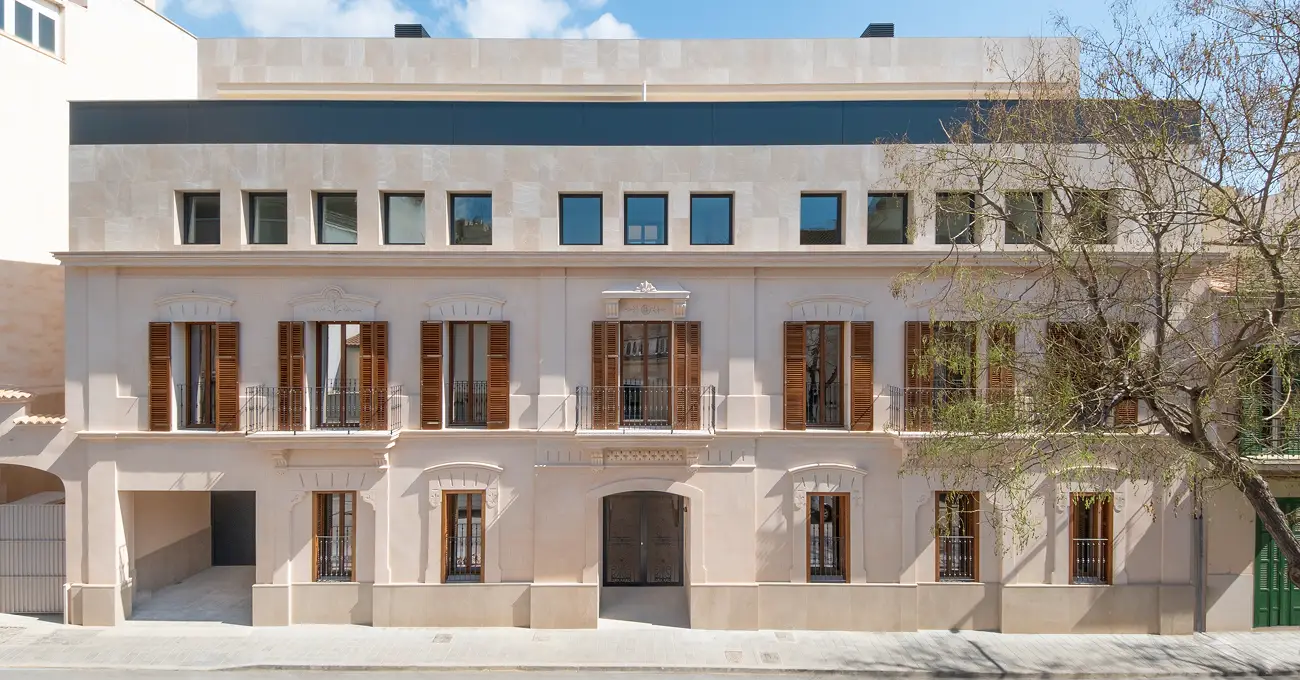
Mallorca has an extraordinary architectural heritage made up of manor houses, traditional country estates, urban buildings, religious buildings and many other properties that are part of the island’s history and identity.
Refurbishing historic buildings in Mallorca is about much more than renovating an old construction. It is a technical and architectural process in which the key is finding the balance between preserving the original value of the property and adapting it to today’s needs in terms of comfort, energy efficiency, accessibility and functionality.
At Construcciones Llull Sastre, more than 90 years of building and refurbishing in Mallorca have allowed us to take part in many projects where contemporary architecture and heritage coexist within the same building.
What does refurbishing a historic building involve?
Unlike a conventional renovation, refurbishing an old property starts with an in-depth understanding of the existing building.
Stone walls, protected façades, beams, arches, courtyards, ornamental features, joinery, roofs or original structures can become key elements of the new project.
Before work begins, the condition of the building must be carefully studied to determine which elements should be preserved, which can be recovered and which construction solutions will be needed to guarantee its stability and durability.
Every building has different conditions and, precisely for that reason, every refurbishment requires specific solutions.
Preserving the original essence of the building
One of the main goals when refurbishing architectural heritage is to preserve the elements that give the property its identity and historic value.
In many projects this means restoring original façades, recovering existing architectural features, keeping certain materials or respecting the layout of unique spaces.
The intervention must be careful.
It is not about transforming a historic building until its character disappears, but about ensuring that its original architecture takes centre stage again within a building ready for a new chapter.
In Mallorca, where natural stone, inner courtyards, traditional façades and certain construction techniques are part of our architecture, this sensitivity is especially important.
Architectural tradition and modern technology
Refurbishing does not mean giving up the performance of a contemporary home or building.
One of the biggest challenges of a comprehensive refurbishment of an old building is precisely incorporating modern services without altering its architectural essence.
Air conditioning, aerothermal systems, underfloor heating, lighting, home automation, thermal and acoustic insulation, new electrical installations or energy-efficiency systems must be carefully integrated into structures that, in some cases, were built more than a hundred years ago.
The result should make it possible to enjoy the historic value of the building with the levels of comfort expected today.
The structure: one of the great challenges of refurbishment
In some historic buildings a large part of the original structure can be preserved. In other projects, however, more extensive structural work is required.
Reinforcements, replacement of floor slabs, consolidation of walls, new interior structures or foundation work may all form part of the project.
All of this requires close coordination between architects, engineers, site management, the contractor, specialists and suppliers.
Planning becomes especially important because, during a refurbishment, situations may arise that are not always visible in the early stages of the project.
That is why experience in this type of work makes it possible to anticipate solutions and respond more precisely to the particular features of each building.
Energy efficiency in historic buildings
Another major challenge today is improving the energy performance of buildings designed at a time when efficiency criteria were completely different.
A well-planned refurbishment can considerably improve a property’s performance through work on the building envelope, services, climate control, windows and doors or energy generation systems.
The aim is to achieve more efficient, comfortable and sustainable historic buildings, while respecting the architectural elements that must be preserved.
New uses for buildings with history
Refurbishment also allows buildings that have served a particular purpose for decades to adapt to new needs.
Old residential buildings can be transformed into contemporary homes; historic buildings can house hotels, schools, institutional spaces or new facilities.
This ability to adapt extends the useful life of the building and prevents properties of great architectural value from falling into disuse.
In this sense, refurbishing also means preserving heritage for future generations.
Our refurbishment experience in Mallorca
Throughout our history, at Construcciones Llull Sastre we have had the opportunity to work on a number of unique buildings in Mallorca.
One of our recent projects is Son Sunyeret, in Palma, an early 20th-century manor building whose listed façade was fully preserved while a new interior structure was built for a contemporary residential project.
We have also taken part in the refurbishment of buildings for new uses, where the challenge was to respect their historic architecture while incorporating the services and features needed for their new purpose.
Every project confirms an idea that is part of how we understand construction: before working on a historic building, you have to understand it.
Understand how it was built, what its essential elements are and how it can evolve without losing what makes it special.
Refurbishing is preserving, adapting and ensuring continuity
Mallorca will keep evolving, and so will its buildings.
Refurbishment allows architecture built decades or even centuries ago to remain an active part of our towns and cities.
Preserving a façade, recovering a structure, restoring a traditional feature or incorporating new technologies into a historic building are decisions that require technical knowledge, planning and respect for the existing architecture.
At Construcciones Llull Sastre we see refurbishment as a way of connecting past and future.
After more than 90 years building in Mallorca, we continue to work towards the same goal: preserving what deserves to remain and building the solutions that will keep these buildings alive for many decades to come.